Champions League 2027 Yokohama: Can Overseas Players Enter?
The Rundown
- Entry now closes August 21, 2026 at 12:00 JST and the lottery result lands August 28 at 14:00 JST — both extended by a week on August 17. The event runs September 20–22 at Pacifico Yokohama Halls A–D. The entry fee is free.
- Seats: Master League 10,000 total (5,000 each on Sept 20 and Sept 21), Senior 1,000 per day and Junior 1,000 per day across Sept 21 and Sept 22. Advance application only — there is no same-day entry.
- Only Japanese-language cards are legal in the deck, so an English collection cannot be played on the floor, and signed cards are ruled out as well.
- Nothing in the rules bars a non-resident. A passport is item 1 on the accepted photo-ID list, and Master and Senior players may be approached for an ID check during the event.
- General spectating is free, needs no lottery, and is open to anyone — but only on September 21 and 22. There is no general spectating on September 20.
Need something from Japan? Send a want list, get a free sourcing report. Send a want list →
Contents
- Can an overseas player enter Champions League 2027 Yokohama?
- The seats, the leagues, and who gets asked for ID
- The clause that actually decides this: Japanese communication
- Only Japanese-language cards are legal
- Master League runs on LINE, Sekanavi, and a Players Club account
- The expensive mistake is the calendar, not the entry
- What you’re actually playing for
Champions League 2027 Yokohama was announced on August 7, 2026, and the entry window closes seven days later. If you’re outside Japan and you’ve been waiting for a Japanese Pokémon TCG event you could actually fly in for, this is the one worth reading carefully — because the barriers are not the ones people assume. Nothing in the published rules bars a non-resident: the entry fee is free, and a passport is item 1 on the accepted photo-ID list. The rules that will stop you are about language and card printings, not about where you live.
Can an overseas player enter Champions League 2027 Yokohama?
On the published rules, yes — there is no residency or nationality clause, entry costs nothing, and a passport is the first document listed for the venue ID check. But entry closes August 21 at 12:00 JST, the result is not announced until August 28 at 14:00 JST, and the tournament reserves the right to disqualify a player whose Japanese is not good enough to keep a match moving.
Updated August 18, 2026: the organizer extended both dates by a week on August 17 after an incorrect link on the Championship Series 2027 schedule page. The dates below are the current ones — see what the extension changes.
That last clause is the real gate, and we get to it below. First, the clock, because it’s the part that expires this week.
| Step | When (JST) |
|---|---|
| Entry window opened | August 7 (Fri), 14:00 |
| Entry closes | August 21 (Fri), 12:00 |
| Lottery result announced | August 28 (Fri), 14:00 |
| Deck registration in the Players Club | By 8:30 on each day you play |
| Event | September 20 (Sun) – 22 (Tue), Pacifico Yokohama Exhibition Halls A/B/C/D |
Hours are September 20 from 10:00 to 19:00, and September 21 and 22 from 7:30 to 21:00, with entrance reception expected to close around 18:00. The announcement states the tournament is advance-application only — 「大会は事前申込制です。当日参加はございません。」 — so there is no walk-up lane on the day. Bag inspection runs at the entrance on every entry, and again on every re-entry.
If applications exceed the seats, the draw is weighted. The outline says entrants who have lost more lotteries since the last Champions League or Japan Championships 2026 event they won — across events held from September 2025 through June 2026 — get a higher win probability. A first-time applicant from abroad has no accumulated loss history, so that weighting works against you rather than for you.
The seats, the leagues, and who gets asked for ID
Age division is fixed by birthdate, not by self-selection, and it determines which days you can even be drawn for.
| League | Born | Days | Seats | Photo-ID check |
|---|---|---|---|---|
| Master | on or before April 1, 2009 | Prelims Sept 20 or Sept 21; finals Sept 22 | 10,000 total — 5,000 per prelim day | Yes |
| Senior | April 2, 2009 – April 1, 2015 | Sept 21 or Sept 22 (each a self-contained one-day event) | 1,000 per day | Yes |
| Junior | April 2, 2015 or later | Sept 21 or Sept 22 (each a self-contained one-day event) | 1,000 per day | Not listed |
The identity check is new in scope and worth reading precisely. The official notice says Master and Senior participants are subject to verification during the event, carried out on players whom staff approach — not on everyone, this time, and the page says so explicitly, framing it as a compromise to let more people take part while they build toward checking everyone in future. If you’re approached and can’t be verified, you’re disqualified from that tournament, you cannot continue, and prizes and participation items already handed to you are reclaimed. Playing on somebody else’s account gets both the lender and the borrower suspended.
The accepted documents, original only, in the official order: 1. passport, 2. driver’s license, 3. Basic Resident Register card with photo, 4. Special Permanent Resident Certificate or Residence Card, 5. disability certificate, 6. credit card with photo, 7. My Number Card with photo (the notification card is not accepted), 8. student ID with photo, currently enrolled.
That list is the friendliest thing in this whole announcement for a visitor. A passport clears the check outright. And this is a different system from the My Number Card verification the Players Club rolled out for the 30th anniversary product lotteries — that one is a government-record gate on your account, and we covered why it closes the door on overseas buyers in our piece on Players Club My Number verification. Here, nobody is asking for a My Number Card. They’re asking whether the face at the table matches the name on the entry.
The clause that actually decides this: Japanese communication
Buried in the notes of the tournament outline, with no heading and no emphasis, is the sentence that matters most to anyone reading this in English.
💡 The language clause, verbatim
「大会では、本人による日本語でのコミュニケーションを基本とします。言語の問題により大会進行に支障をきたす場合、主催者判断により失格となる場合があります。」
Our translation: "At the tournament, communication in Japanese by the player themselves is the baseline. If language problems cause an impediment to the running of the tournament, disqualification may result at the organizer's discretion."
Read the two halves separately, because they do different work. “By the player themselves” rules out bringing a friend to interpret at the table — the standard is your own Japanese, not your party’s. The second half is a discretionary disqualification, not a fixed test: there is no published proficiency level, no exam, and no stated appeal. It triggers on whether a judge decides your language is impeding the event.
In practice that means the question isn’t “do I speak Japanese,” it’s “can I run a 35-minute Swiss match in Japanese — call effects, answer a judge, report a result — without slowing the room down.” Nobody outside the organizer can tell you where that line sits, and we’re not going to invent a threshold that the official pages don’t publish. What we can say is that the clause exists, that it is written as grounds for disqualification, and that Master League adds a Japanese-language app on top of it.
Only Japanese-language cards are legal
The regulation section states it once and the what-to-bring list repeats it: 「レギュレーションに沿った日本語のカードのみ、使用可能」 — only Japanese-language cards conforming to the regulation may be used. Standard regulation, 60-card deck, 6 prizes. Signed cards are in principle not usable.
So the collection you’ve built at home is, for this specific purpose, decoration. Not because it’s fake or because the cards are different — the gameplay differences between Japanese and English prints are essentially nil — but because the tournament checks the printing, and yours is the wrong one. You either buy a Japanese deck in Japan in the days before the event, competing for the same singles as 10,000 other players who are also finalizing lists, or you arrive with it already built.
🗼 What we can do about this
The rule that makes your existing deck unusable is the printing, not the cards — only Japanese-language cards are legal at Champions League 2027 Yokohama, and there is no proxy or translation allowance. Send the desk the decklist you intend to play and we check the Japanese market for it — shop stock and the domestic secondary market — then send back a free report: the listings we would pick for each single, the yen price, condition notes, and an all-in estimate including proxy fees and shipping to your country, so there are no per-card surprises after the fact. You buy directly from the links; our job is finding the best way to buy it from Japan and telling you. What nobody can do, and we will not pretend to, is enter the lottery for you: entry is tied to your own Players Club account and checked against your own photo ID at the venue.
Get a free report on your decklist →
The Tokyo Sourcing Desk is our own free service. Editorial policy.
Master League runs on LINE, Sekanavi, and a Players Club account
Master League prelims use a real-time Swiss format where pairings, timers and result reporting all happen inside LINE. The outline is specific about what that requires of you:
✅ Master League, before you can play
- Your own Player ID from the Pokémon Card Game Players Club.
- Your own smartphone — one person, one device, one account. Tablets including iPad are explicitly not accepted.
- Your own LINE account, since match pairings and table assignments are pushed to you there.
- The Sekanavi (セカナビ) tournament platform, a Sekappy Inc. product that runs inside LINE. Its portal is published in Japanese.
- If you win a seat: complete 大会登録 (tournament registration) in Sekanavi by the day before, or you may not be able to play.
- Deck registered in the Players Club by 8:30 on each day you play. Missing that deadline carries a penalty.
Everything upstream of that runs on the Players Club account, which is where our verification runs out. We could not confirm whether an overseas collector can complete Players Club registration. Here is exactly what we could and could not check: the sign-up form’s first step asks only for an email address and a date of birth, and the club’s own FAQ lists the full registration inputs as date of birth, nickname, legal name, email address, mobile phone number, gender and address, plus SMS verification to that mobile number — and states that without SMS verification you cannot submit event entries at all. One phone number cannot be linked to a second account. What the FAQ does not say is whether a non-Japanese mobile number passes that SMS step, or whether the address field accepts an address outside Japan. Confirming either would mean creating an account with real personal data, which we’re not going to do to test a hypothesis. Treat it as the open question in your plan, not a solved one.
The expensive mistake is the calendar, not the entry
⚠️ Do not book September 20–22 before August 28 at 14:00
Entry costs nothing, so the entry itself risks nothing. The money is in the trip — and September 20–22, 2026 is a Sunday plus two consecutive public holidays, one of the busiest domestic travel weekends of the Japanese autumn, in a city hosting a 10,000-seat event. The lottery result does not post until August 28 at 14:00 JST, which is 23 days out. Book before that and you are buying peak-holiday Yokohama and Tokyo rooms on the chance of a seat you may not get.
There’s a version of this trip that survives losing the lottery, and it’s worth building deliberately rather than as a consolation. General spectating requires no lottery, costs nothing and is open to anyone — but only on September 21 and 22. There is no general spectating on September 20, so a ticketless traveler arriving Saturday for the Sunday opening day sees the outside of the building. And Yokohama is 30 minutes from central Tokyo, which means the Tokyo card shop circuit is intact either way, as is the general-retail calendar on our Japanese release schedule.
What you’re actually playing for
Worth calibrating expectations before you spend on airfare: this event awards no Championship Points. The prize page says so outright. Participation prizes are a promo Riolu (リオル) and a promo basic Energy card. Win prizes are a promo MEGA Zeraora ex (メガゼラオラex), a promo Mega Signal (メガシグナル), an original deck shield set, and a Pokémon HOME commemorative medal. The Championship Series 2027 overview describes a separate priority-entry route into the Japan Championships 2027 for Master League players who reach 12 combined wins across the prelims and the first final stage — that path is the competitive reason to be there, not the points.
So the honest summary for an overseas player: the paperwork barrier is lower than at the Japanese product lotteries and lower than the face-recognition entry rules now used at Pokémon Card Store pop-ups, because there’s no residency test and a passport clears the ID check. The barriers that remain are ones you either have or don’t — enough Japanese to run a match under a discretionary disqualification clause, a Japanese-language deck, a LINE account and a Japanese-language tournament app on your own phone, and an account whose overseas registrability we could not confirm. Enter by August 21 at 12:00 if those line up. Book nothing until August 28 at 14:00 either way.
Frequently asked questions
What does it cost to attend Champions League 2027 Yokohama?
The tournament itself is free — the official announcement lists 参加費用 (entry fee) as 無料, and general spectating on September 21 and 22 costs nothing either. No admission fee, reservation fee or paid priority lane is published anywhere on the official pages, so anyone selling you guaranteed access is not selling something the event offers. Your real costs are airfare, a Yokohama or Tokyo room over a Sunday-to-Tuesday holiday weekend, and building a Standard-legal deck out of Japanese-language cards.
Do I need to be a resident of Japan to play?
No residency or nationality requirement appears in the published rules for this event. The tournament outline gates entry on age division, a Players Club Player ID, one entry per person, and guardian consent for under-18s. The photo-ID list for the venue check leads with a passport, which is the document a visitor is most likely to be carrying. What we could not verify is whether the Players Club account itself can be created from abroad — see the section on that in the article.
Can I use my English Pokémon cards in the tournament?
No. The outline states plainly that only Japanese-language cards that fit the regulation may be used, and repeats it in the what-to-bring list. Standard regulation applies, decks are 60 cards with 6 prizes, and signed cards are in principle not permitted. If you are flying in with an English deck, it is not legal on the floor, and there is no translation or proxy allowance described.
Are Championship Points awarded at this event?
No. The prize page states there is no awarding of Championship Points at Champions League 2027 Yokohama. Participation prizes are a promo Riolu (リオル) and a promo basic Energy card; win prizes are a promo MEGA Zeraora ex (メガゼラオラex), a promo Mega Signal (メガシグナル), an original deck shield set, and a Pokémon HOME commemorative medal. The Championship Series 2027 overview separately describes a priority-entry path into the Japan Championships 2027 for Master League players reaching 12 combined wins across the prelims and the first final stage.
If I lose the lottery, is there any way in?
Not as a player. The announcement is explicit that the tournament is advance-application only with no same-day participation. What is open is 一般観覧 (general spectating), which requires no lottery, costs nothing and is open to anyone — but only on September 21 and 22, with no general spectating on September 20. Bag inspection applies at the entrance on every entry and re-entry.
 ONE PIECE ST-37 & ST-38 Baroque Works Start Decks: Dec 19, ¥1,320
 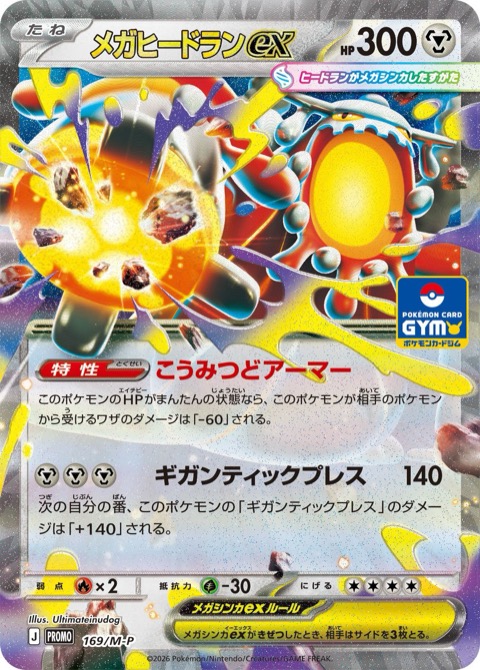 Mega Heatran ex Promo: Japan's Promo Card Pack Vol. 6 From Nov 1
  Champions League 2027 Chiba: Entry Closes Oct 16 for Overseas Players
  Pokémon Card Shows in Japan 2027: Events Visitors Can Actually Attend