30th Celebration Classic Collection: Why Charizard & Lugia Doubled
The Rundown
- The Classic reprint of the 1996 Base Set Charizard (137/103) went from ¥14,800 to ¥34,800 at yuyu-tei between September 17 and 23, 2026: +135% in six days. Cardrush asks the same ¥34,800.
- The Crystal-type Lugia reprint (142/103) went ¥19,800 → ¥29,800 (+51%) and is sold out at yuyu-tei; Cardrush has it at ¥32,800. The original it reprints sells for about $3,100 raw and $81,000 in PSA 10.
- Only 9 of the 30 Classic reprints rose. 16 fell; most of the subset now sits at ¥420–780. The market is picking era icons, not buying the subset.
- Both shops' buyback offers are now 70–72% of their own asking price on these two cards, against a set-wide median of ~20% a week ago. Shops are paying up to restock, which is what a real bid looks like.
- Community box data puts the Classic slot at 2 cards per 20-pack box across 30 kinds: a specific card roughly once per 15 boxes, about ¥300,000 of boxes at the current ¥20,000 street price.
Want a real number on a specific card? We check what it's listed for in Japan today. Send a want list →
Contents
Where to buy: 30th Classic Collection reprintseBay(paid link)Mercari via Buyee(paid link)Yahoo! Auctions via Buyee(paid link)Fees and what to read first ↓
A week ago you could buy the 30th CELEBRATION reprint of the 1996 Base Set Charizard for ¥14,800 in Japan. As of September 23, 2026, the two large singles shops we track both ask ¥34,800, a 135% rise in six days, and the Crystal-type Lugia reprint has gone from ¥19,800 to ¥29,800 and sold out at one of them. This article shows the move day by day from our own snapshots, then walks through what is actually driving it — and what part of the story nobody can verify yet.
What happened, day by day
We snapshot the full 30th CELEBRATION singles list at yuyu-tei once a day. The 30 historic reprints, numbered 136/103 to 165/103 above the set’s regular numbering, first appeared on the shop’s list on September 17, the day after release. Here is what the two headline cards did:
The whole move happened in two steps: between the September 18 and 19 snapshots, the set’s first Friday night into Saturday, both cards jumped to ¥29,800, and Charizard took a second step to ¥34,800 on the 21st. Prices in between did not wobble; the shop repriced, and the new price held.
Two more readings say this is a bid, not a hopeful sticker. First, this is not one shop: Cardrush, the other large Tokyo singles shop, asked ¥34,800 for the same Charizard and ¥32,800 for the Lugia when we checked on September 23, with 40 and 43 copies in stock respectively, so these are working prices on real inventory. Second, the buyback offers moved with the asks: yuyu-tei now offers ¥25,000 buyback on the Charizard (72% of its own ask) and ¥21,000 on the Lugia (70%). When we surveyed the whole set in launch week, the median buyback was around 20% of ask. A shop that offers 70% is competing to restock a card it expects to resell immediately.
What these two cards actually are
The 30 reprints are the set’s history feature: the official 30th site describes them as 30 cards symbolizing the game’s 30 years, reissued in a special finish with a gold anniversary Pikachu stamp. English product sells the same line as the Classic Collection. Japanese shops file them under 復刻版 (reprints).
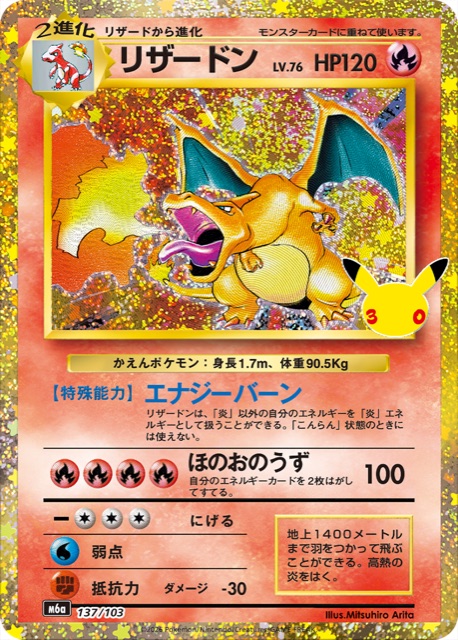
137/103 is the 1996 Base expansion Charizard: the same Mitsuhiro Arita artwork and card text (Energy Burn, Fire Spin, LV.76, HP120) that defines “expensive Pokémon card” in the popular imagination. A near-mint original starts around $800 in English per TCGplayer’s September 18 report, and far more graded.
Official product image © The Pokémon Company (from the linked official page).
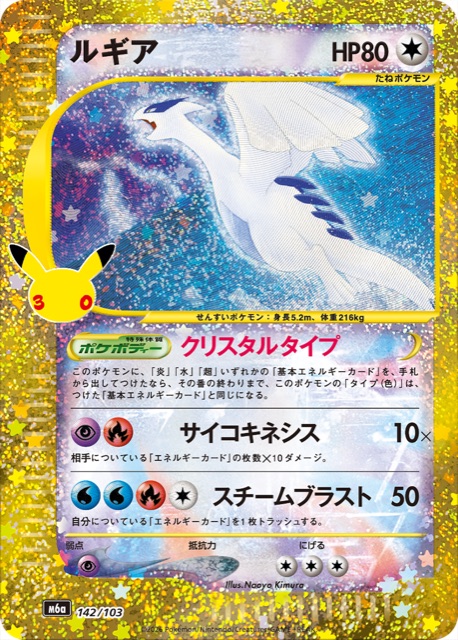
142/103 is the Crystal-type Lugia from the early-2000s e-Card era: Poké-Body “Crystal Type”, Naoyo Kimura art, known to English collectors from 2003’s Aquapolis. The original is one of the hobby’s genuine grails, and it has itself been running: per Wargamer, ungraded copies that sat at $300–800 for years reached about $3,100 by late August 2026, with PSA 10 copies around $81,000. The reprint is the first official way to own that image for less than a used car. On day one, the English version of this reprint was the most expensive card in the entire English set at roughly $270 — ahead of every new SAR and both Futuristic Rares.
So the two risers are not random: they are the two slots in the 30 whose originals carry five-to-six-figure grade ceilings. The market did not buy “the reprint subset”. It bought the two icons and mostly ignored the rest. (For the set’s regular SAR and FUR tier, which moved the other way this week, see the full chase-card list.)
The other 28: a two-tier market inside one subset
Across the 29 reprints continuously listed at yuyu-tei, 9 rose, 4 are flat, and 16 fell between September 17 and 23. The falling tier fell hard: most of the subset now asks ¥420–780, down 26–38%. Same packs, same pull odds, opposite direction.
| # | Card | Sep 17 ask | Sep 23 ask | Change |
|---|---|---|---|---|
| 137 | リザードン (Charizard, Base Set 1996) | ¥14,800 | ¥34,800 | +135% |
| 144 | わるいバンギラス (Dark Tyranitar) | ¥1,780 | ¥2,980 | +67% |
| 160 | ピカチュウ&ゼクロムGX (Pikachu & Zekrom GX) | ¥2,480 | ¥3,980 | +60% |
| 142 | ルギア (Crystal Lugia) | ¥19,800 | ¥29,800 | +51% |
| 141 | ひかるセレビィ (Shining Celebi) | ¥3,480 | ¥4,980 | +43% |
| 136 | ピカチュウ (Pikachu, 1996) | ¥4,980 | ¥6,980 | +40% |
| 154 | レックウザEX (Rayquaza EX) | ¥2,480 | ¥3,480 | +40% |
| 150 | ゲンガー (Gengar Prime) | ¥6,980 | ¥8,980 | +29% |
| 163 | ミュウVMAX (Mew VMAX) | ¥1,980 | ¥2,480 | +25% |
| 139/145/146/147 | Erika’s Jigglypuff · Scizor ex · Metagross δ · Palkia LV.X | ¥780–980 | flat | 0% |
| 138 | カスミ (Misty) | ¥1,980 | ¥980 | −51% |
| 151/152 | ダークライ&クレセリアLEGEND (top/bottom) | ¥2,980 each | ¥1,780 each | −40% |
| 155/158/159/161 | Genesect EX · Solgaleo GX · Buzzwole GX · Zacian V | ¥680 | ¥420 | −38% |
| 153 | N | ¥2,480 | ¥1,780 | −28% |
| 140/143/148/149 | Sneasel · Delcatty · Uxie · Crobat G | ¥780 | ¥580 | −26% |
| 156/157/162/164 | M Gardevoir EX · Greninja BREAK · Raikou · Arceus VSTAR | ¥780–980 | ¥680–780 | −13〜−20% |
(English names are the Pokémon or character on the card, not official English card names. One card is missing from the table: 165/103 コイキング (Magikarp), a reprint of the Paldea Evolved fan favorite, which vanished from yuyu-tei’s list after September 18 at ¥7,980; Cardrush listed it at ¥9,480 and sold out on September 23, and TCGplayer had the English one around $150. Thin supply, no continuous series, so we leave it out of the trend table.)
Why the spike happened: the parts we can verify
1. Day-one Japan was priced below the world. This was the first worldwide simultaneous release, so for once the same chase cards had a same-day price in two markets. On September 17 Japan asked ¥14,800 for the Charizard while TCGplayer’s day-one English read was $160, and ¥19,800 for a Lugia the English market led the set with at ~$270. Japanese shops opened low, watched the sell-through, and repriced across the first weekend. Most of the “spike” is Japan converging up to the global number, and for Charizard past it.
2. A specific icon is genuinely hard to pull. Official pull rates are unpublished, but community box-opening tallies in the first days converged on 2 Classic reprints per 20-pack box, across 30 kinds.
The arithmetic of pulling one yourself
If the observed rate holds, a specific card like the Charizard averages one per ~15 boxes. That is about ¥108,000 of packs at the official ¥7,200 box price, except boxes actually trade around ¥20,000, making the pull-it-yourself route roughly ¥300,000 per targeted card. Against that arithmetic a ¥34,800 ask is the cheap way in, which is why it keeps finding buyers on 40 copies of shop inventory.
🗼 What we can do about this
The two shop asks in this article agree with each other, but they are asks on graded-by-the-shop condition tiers, and the marketplaces underneath them mix reprints, vintage originals and conditions in one search result. If you are weighing the ¥34,800 shop copy against a Buyee listing that looks cheaper, send us the collector numbers you want — 137/103, 142/103, or any of the 30 — and the free report comes back listing by listing: which listings are the m6a reprint rather than something older, the yen price on live copies against both shops' asks and buybacks, and an all-in estimate including proxy fees and shipping to your country. You buy directly from the links. Our job is finding the best way to buy it from Japan and telling you, and if the honest answer is that the English print at your local shop beats every Japanese route this week, that is what the report says.
The Tokyo Sourcing Desk is our own free service. Editorial policy.
3. The resale valve was closed on release day. Mercari, Japan’s largest flea-market app, announced on September 15 that sealed 30th CELEBRATION product could not be listed from September 16 for a fixed period, with delistings and account penalties for violators. Pokémon Center Online sold its own allocation by lottery. With the two cheapest domestic supply routes constrained, early singles demand concentrated on the shops whose prices you are reading, and openers who did pull an icon had fewer venues undercutting the shop ask.
4. Shops are bidding, not just asking. The 70–72% buyback ratios above are the strongest single signal in our data. A shop does not offer ¥25,000 cash for a card it doubts it can resell at ¥34,800.
What nobody can verify yet
Honest limits, because a one-week-old market punishes certainty. The print run is unknown: The Pokémon Company has said nothing about supply, and a reprint wave or extended print run would change this arithmetic overnight. The pull-rate figures are community tallies, not official data. And we do not track English singles daily: TCGplayer’s own day-one read expected short-term declines set-wide as supply lands, so the two markets may be converging from both directions. Whether ¥34,800 is a launch-window peak or a floor is exactly the question our tracker exists to answer over the coming weeks, not something anyone can state today.
⚠️ The reprint and the vintage original are nearly identical in a search result
The reprint uses the original artwork and card text. On eBay, Mercari or Yahoo! Auctions, a listing titled "Charizard Base Set" can be a ¥34,800 reprint or an $800-plus 1996 original, and sellers do not always say which. Before paying either price, check three things in the photos: the m6a set code bottom-left, a collector number above the denominator (137/103, 142/103), and the gold 30th anniversary Pikachu stamp on the artwork. All three mean 2026 reprint. None of them means you are being offered the vintage card — price it as one. Condition tiers matter too: Cardrush's B-grade copy of the same Charizard asks ¥19,800 against ¥34,800 for near-mint, so a "cheap" copy may just be a worn one.
So what for overseas collectors?
The reprints exist in English in the same worldwide release, so the Japanese print is a choice, not the only door: you are paying for the Japanese card text and, right now, a market that repriced 135% in six days. If you want the icon on your desk, price the English copy at your local shop first against the day-one $160/$270 marks and take the cheaper door; the gap between the two markets is a running theme we measured in JP vs US card prices. If you specifically want the Japanese m6a print, buy it by collector number from a shop list or a verified marketplace listing, and check our daily price tracker first, because every number in this article has a date on it, and the next date may differ.
Frequently asked questions
What is the Charizard 137/103 in 30th CELEBRATION?
It is a special-finish reprint of the 1996 Base expansion Charizard: same Mitsuhiro Arita artwork, Energy Burn and Fire Spin text, LV.76 and HP120 — numbered 137/103 above the set's 103-card denominator and carrying a gold 30th anniversary Pikachu stamp on the art. It is part of a 30-card line of historic reprints in the set (sold in English product as the Classic Collection). Per the official 30th site, these reprints are not usable in the current Standard regulation.
What is the Lugia 142/103 in 30th CELEBRATION?
A reprint of the Crystal-type Lugia from the early-2000s e-Card era, known to English collectors from 2003's Aquapolis: Poké-Body Crystal Type, Naoyo Kimura artwork. The original is a grail: around $3,100 ungraded as of August 2026 after years at $300–800, and roughly $81,000 in PSA 10, which is why an official reprint at two orders of magnitude less finds buyers fast.
How rare are the Classic Collection reprints in Japanese packs?
The Pokémon Company has not published pull rates. Community box-opening data compiled in the days after release points to 2 Classic reprints per 20-pack Japanese box, drawn from 30 kinds, so a specific card like the Charizard averages out to roughly one per 15 boxes. At the ¥7,200 official box price that is about ¥108,000 of packs; at the ¥20,000 the street actually charges for a box, about ¥300,000. Treat these as observed figures, not official ones.
How much is the 30th CELEBRATION Charizard reprint worth?
As of September 23, 2026, the two large Japanese singles shops we track both ask ¥34,800 for a near-mint copy, and yuyu-tei's buyback is ¥25,000, 72% of its own ask. On September 17 the same card was ¥14,800. The English version was around $160 on TCGplayer on September 18. These numbers move daily; our price tracker shows the current Japanese ask.
Can I play the 30th CELEBRATION reprints in tournaments?
Not in Standard. The official 30th anniversary site states the 30 historic reprints cannot be used in the current Standard regulation; they remain legal only in formats where the original card is. Buy them as collectibles, not deck cards.
 Ninja Spinner Card Prices in Japan: Mega Greninja ex MUR at ¥59,800
  Abyss Eye Card Prices in Japan: Mega Darkrai ex MUR at ¥34,800
  30th CELEBRATION Prices in Japan: Box ¥25,000, Top Single ¥24,800
  Pokémon Card Collection Apps: Do They Work for Japanese Cards?